Within the intensely competitive arena of today's serious drifting, success is no longer purely a product of brute horsepower or behind-the-wheel courage. Rather, it has become a multifaceted discipline that necessitates a painstaking marriage of selecting a time-tested vehicle platform, equipping it with the highest-quality competition components, and, most critically, grasping its real-time behavior on the course through sophisticated vehicle dynamics analysis tools. This exhaustive handbook will serve as your master plan starting from the very first concept of a competition vehicle right through to the last telemetry-optimized adjustments that elevate a powerful car into a consistent podium finisher. We will delve deep into the methodical process of vehicle alignment optimization, showing how a state-of-the-art drift tuning app like a dedicated telemetry system eradicates guesswork and offers unparalleled visibility into your chassis's actual dynamics.
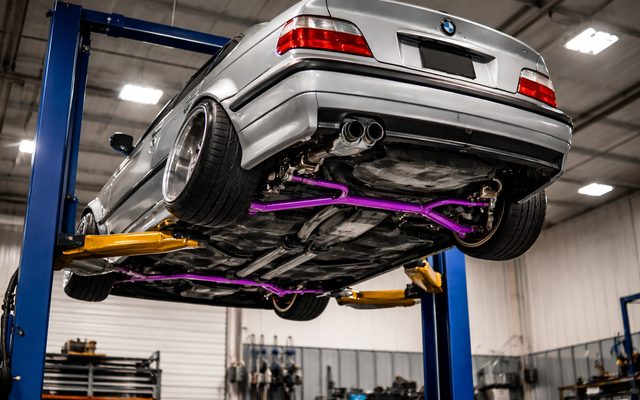
The cornerstone of any successful drift car is, undoubtedly, the base vehicle itself. Certain cars have attained renowned status within the worldwide oversteer community due to their natural handling characteristics, durable construction, and the immense availability of aftermarket parts available. Choosing the optimal platform is the primary and most important decision a enthusiast will make. As an example, the the E36 generation BMW is widely regarded as one of the finest overall cars for drifting of the modern era. Its near-perfect balanced front-to-rear weight, combined with a RWD setup and robust six-cylinder engines, creates a chassis that is both forgiving for beginners and incredibly effective in the possession of a professional driver. The successor of this philosophy, the BMW E46 platform, improves on these attributes with a increasingly sophisticated structure, broader wheel track for improved high-speed stability, and still a greater degree of lock directly from the manufacturer. A different formidable option in the top-level scene is the Corvette C6.
This muscle-derived performance car introduces a particular array of advantages to the sideways discipline, such as a light aluminium structure, a transaxle-style gearbox and differential unit that helps create an excellent balance, and the colossal low-end power of a big LS V8 motor. This combination makes it an absolute weapon on track, designed of starting and sustaining extended angles with relatively effortless deployment of throttle. For drivers desiring remarkable bang-for-the-buck, the 350Z model Nissan excels as a prime candidate. It comes from the factory with a robust chassis, a decent original LSD, and the responsive VQ series engine that delivers plenty of horsepower and torque for learning and progressing in the discipline. Its successor, the 370Z model, brings additional refinements in chassis stiffness, suspension design, and outright powerplant output, solidifying its position as a popular selection among professional competitors. Further iconic vehicles that merit mention encompass the lightweight unique FC generation RX-7, the ubiquitous Nissan S13, the torque-rich Ford SN95, the more recent BMW E90, and the tiny yet surprisingly engaging and teachable MX-5 Miata. All of these cars offers a different palette of traits, complexities, and capabilities, but they all share the basic components necessary to become a serious drift machine.
However, picking the right car is just the starting point. To unlock the full capability of every of these vehicles, major modifications to the steering system and suspension systems are absolutely essential. This is where the world of performance aftermarket components enters critical importance. The one most game-changing modification for a purpose-built drift machine is the installation of a maximum-angle steering angle kit. These engineered assemblies, for example those manufactured by industry leaders like SLR, are designed to radically increase the vehicle's maximum steering angle. A standard street car is severely limited in how far its tires can pivot, a safety limitation for daily driving. In sliding, but, maximum opposite lock is constantly required to catch and sustain a angle. An steering kit substitutes the OEM steering knuckles, tie rods, and potentially A-arms with parts that allow the wheels to attain steering lock beyond 70 or even 80 degs, versus a typical OEM angle of around 40 to 50 degs.
This vastly greater capability gives the driver with significantly greater control during a angle, enabling it to be much easier to begin a drift, sustain it through a sweeping turn, and transition fluidly from one angle to another. The improvement in controllability is nothing short of profound. Coupled with a properly chosen angle kit is the every bit as essential enhancement to the car's suspension. Store-bought or even expensive street dampers are simply not intended for the specific and extreme requirements of competitive oversteer. A purpose-built system of adjustable dampers is paramount. These specific coilovers incorporate unique damping rates and spring strength that are optimized for the extreme weight transfer that is inherent of aggressive driving. When a pilot begins a drift, the car's inertia is thrown rapidly to the front of the corner. Correct performance coilovers control this shift in a predictable way, permitting the chassis to stabilize promptly and giving the pilot precise feedback through the controls and driver's seat. They also enable exact tuning of ride height, shock absorber stiffness, and corner weighting, which are all key elements of optimizing the vehicle's handling to a particular circuit or piloting approach. In combination, a top-tier steering angle kit and a expertly specified pair of drift-spec adjustable dampers constitute the core mechanical foundation upon which all later optimization is built.
Once the essential hardware is installed, the subsequent essential phase in the development is the detailed adjustment of the vehicle's alignment. This is the domain of vehicle alignment optimization, a methodology that can seem daunting to the beginner but is, in fact, the key to transforming a set of high-performance components into a unified and predictable whole. The most discussed aspect of alignment for drifting is undoubtedly camber. Wheel camber is the angle of the wheel relative to the vertical plane when observed from the front of the chassis. If the upper part of the wheel is leaning towards the chassis, this is known as camber-in. In drifting, inward-leaning wheels on the front axle tires is universally used and is considered critical. The logic is fundamentally linked to vehicle dynamics.
When a chassis is turning at limit slip angles, the chassis leans towards the outside of the bend. This chassis roll makes the outer steering tire to lose its optimal contact patch with the track surface. By introducing an inward tilt, the tire is pre-tilted to counteract this tilt. As the chassis leans into the corner, the outside front tire flattens out with the asphalt, increasing its bite at the exact point when it is absolutely essential for control. Typically, front axle camber settings for a dedicated drift car range from approximately -3 degrees to as much as -5 degrees or even beyond, based on the details of the chassis setup, compound type, and pilot preference. The back tires also utilize negative camber, but the values are usually more modest and subtler than the front axle. Overly aggressive inward lean at the back can result in the chassis excessively loose and challenging to manage on power input, as it reduces the available contact patch of the driven tires during straight-line power delivery. Therefore, rear axle adjustments are often in the vicinity of -1 degree to -3 degrees, achieving a delicate compromise between providing sufficient lateral traction to help in entering and holding the drift while still preserving usable traction for acceleration the turn. Camber is only one component of the larger suspension geometry puzzle, which also encompasses toe setting, caster angle, and suspension-induced steering correction.
Toe angle describes the orientation of the tires when viewed from the top. Toe-in means the leading edges of the tires are nearer together than the trailing edges, while toe-out means the reverse. For sliding, a small amount of front toe-out is commonly run to quicken the initial response directional response, making the car feel more agile and willing to begin a slide. Rear toe setting is usually set to zero or a extremely small amount of inward toe to foster stability under power. Caster is the forward or rearward tilt of the kingpin axis when observed from the side-on of the chassis. Positive caster increases steering feel and stability confidence, and it additionally boosts inward lean increase during turning, which is highly beneficial. Setting these values is a complex interplay where a change to one parameter can and will influence the other settings. The traditional process for tuning a car's suspension geometry for drifting has for a long time been a time-consuming endeavor of guesswork and adjustment. A pilot or engineering group would make a modification based on experience, test the vehicle on track, rely on the pilot's personal perception and feedback, and then apply another change. This cycle would repeat time after time until the chassis felt "acceptable" or the allotted practice session ended. This system is not only exceptionally slow in terms of man-hours and resources, but it is additionally fundamentally imprecise.
Pilot sensation is a famously unreliable data source, colored by countless variables such as tiredness, varying track conditions, weather, and simply the mood of the driver on that specific day. What feels "loose" on one pass might feel "tight" on the following lap, causing conflicting data and counterproductive suspension tuning tool tweaks. This traditional limitation in chassis setup is exactly where contemporary telemetry systems has made its mark to transform the methodology.
The advent and application of advanced drift telemetry software has ushered in a radically different age for building and optimizing professional drift machines. This new generation of tools, showcased by innovative products like data acquisition tools, work by directly measuring the live physical behavior of the car as it is being driven on the circuit. Unlike using personal feedback, these tools gather objective metrics on key variables such as suspension travel, individual tire rotation, acceleration forces, steering angle, and accelerator and brake pedal position. This collected information flow is then analyzed by powerful software that can visualize and interpret the metrics in a actionable way. For the very first time, engineers and teams can see exactly what the chassis is doing at every moment of a slide. This ability revolutionizes the entire alignment optimization workflow. Consider the particular goal of setting the front camber for a specific vehicle. As an alternative to making a modification from -3 degrees to -3.5 degrees and then running several passes to try and "feel" a difference, a vehicle dynamics tool can deliver instant and irrefutable feedback. The software can indicate in a chart how the tire's contact patch is acting during the most important stages of a slide: turn-in, holding the angle, and switch. It can demonstrate if the current angle is allowing the outside front tire to maintain maximum grip or if the compound is working inefficiently on its outside edge.
The system can after analysis provide empirical recommendations for modification. Perhaps the data indicates that the outside front tire is even overloading its outer shoulder at -3.5 degrees of camber, implying that even more inward lean, say -4 degrees, might be advantageous. Conversely, the data might indicate that the tire is not reaching heat or that the inside edge is wearing too quickly, which could indicate that there is overly aggressive negative camber and a slight reduction back to -3.2 degrees would be more optimal. This degree of accuracy and practical analysis was completely unimaginable in the era of pure mechanical setup.
The impact of utilizing a dedicated drift telemetry system goes well beyond merely setting camber angles. It becomes an invaluable coilover setup tips that is specific to your exact vehicle. When adjusting the shock absorber values on your coilovers, rather than using imprecise guidelines or copying another team's numbers, you can use the data to see vehicle dynamics tool how the vehicle is reacting in response to your adjustments. The tool can display the suspension travel data over a lap, revealing if the shocks are handling the body movement effectively or if they are permitting the car to oscillate uncontrollably after a flick. It can help in identifying issues like excessive compression or topping out, allowing you to introduce informed decisions to spring preload, rebound/compression values, or ride height. This methodology applies equally to the complex task of suspension geometry optimization. Beyond camber, the system can give insight into how adjustments to toe and caster are affecting the chassis's coilover setup tips handling during specific maneuvers of a lap. For example, it can help you to find the ideal amount of front negative toe for your specific steering setup and competition approach by showing the response time of turn-in reaction and the stability of the vehicle at maximum lock. This turns the tool an extremely powerful vehicle dynamics manual that is actively updated by the actual performance of your specific chassis on the circuit. It shifts the whole project from a dark art into a methodical engineering process.
Furthermore, the utility of a system like GripDial is in no way restricted to experienced teams with vast budgets. For the grassroots driver, it functions as an amazing equalizer. It effectively offers the driver with the insight of a expert dynamics engineer without the typical expense. It accelerates the tuning process by giving clear solutions to questions that would normally take years of experience to answer. A driver can understand how their specific vehicle responds to specific settings, building a more intuitive understanding of suspension theory in the process. It furthermore makes accessible professional chassis dynamics concepts, enabling all drivers with the drive to perfect their car to achieve it in a structured and productive fashion. This is particularly valuable in a activity like sliding, where engineering knowledge has in the past been a closely guarded asset among professional teams. Today, that power can be in the hands of every motivated enthusiast.
In summary, the process to building and optimizing the ultimate high-performance drift machine is a comprehensive endeavor that smoothly integrates proven mechanical wisdom with 21st-century digital tools. It commences with the informed selection of a capable car, then built upon the installation of essential competition components like maximum-angle angle modification systems and properly specified performance coilovers. The process then progresses into the intricate stage of car suspension tuning, where parameters like camber angle, toe setting, and caster are meticulously adjusted to match the car's modified hardware and the operator's personal style. Finally, and what truly separates the modern approach from the past, is the integration of a sophisticated vehicle dynamics tool. This system removes the uncertainty and trial and error of solely feel-based setup by delivering objective, real-time telemetry on how the vehicle is actually behaving. It acts as an incredible suspension tuning tool, a actionable alignment optimization handbook, and a all-in-one vehicle dynamics tool. Together, this holistic methodology ensures that all component of the competition vehicle—from the selection of the car to the most minute adjustment on the damper—is optimized for ultimate success on the circuit. It represents the full evolution of the sport of sliding, merging mechanical car control with precise suspension engineering to create the perfect competitive machines attainable.